Posts

Showing posts with the label Roller

The reassurance of spring

Image
Bee-eater (John Hawkins) Conclusions of recent research on wildlife populations across Europe make for seriously depressing reading , especially for those of us with memories of what things were. Even in Extremadura, where the populations of larks and Corn Buntings appear still robust, my own notebooks carry testimony of the collapse of species such as Little Bustard and Montagu's Harrier. Rachel Carson's arresting image "Silent Spring" has been retrieved by journalists. And so I face this spring with anxiety, foreboding. The rains only started at the end of February and to date we have already received  since then 86% of last year's entire total of rainfall total recorded in the immediate vicinity of our home. Whilst the landscape now looks luxuriously green, it was striking how the wetter and colder weather delayed flowering of many early species this year and how few butterflies were on the wing in the first half of spring. The result has been bittersweet...

Rolling rolling rolling

Image
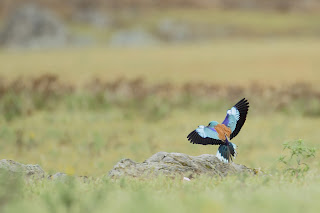
Roller (John Hawkins) Dropping from its perch, the bird performs a low gliding arc, the presumption of which will be a sweeping ascent to another position, further along the line of electricity cables beside the road. Contrarian as ever, the bird breaks from this smooth curve, rises and then enters a chaotic, swerving motion. The wings appear yanked forcibly in opposing directions, causing the bird to wobble dramatically, widely spread they reveal a blast of electric blue, of breathtaking intensity, a vibrant contrast to the soft blue that occupies most of the plumage. This rolling action ends as the bird abruptly takes a perch - and it gives us the common name of the species, the Roller. It had joined its mate and they perched close to each other. They embark on a bowing display, heads held aloft, bills pointing almost vertically upwards and then a series of slow heavy nods, as if concluding some weighty discussion. Incongruous to the sophistication of their plumage, the call whic...

Bustard blessings

Image
Juvenile and female Little Bustards (Martin Kelsey) Finding bustards in early August in a year such as this when the wet spring's legacy has left swathes of tall and brittle grasses is ultimately a question of luck. The first two hours of daylight offers the prospect of yield, for once the sun is high in the sky, the rising temperature forces all creatures on the plains into shade. Crested Larks gather in the dark beneath a manger, an Iberian Grey Shrike will find that wisp of shadow behind a fence post, shuffling into position on its barbed wire perch, and bustards plonk themselves onto the ground and pant. Taking a horizontal view across the fields, the surface bubbles with heat haze, thus converting distant cardoon thistle heads into those of bustards. Add in to this the perfect fusion now in colour of the dry vegetation with that of bustard plumage, then serendipity remains the only recourse. And thus we were blessed yesterday. We made our first stop, just as the sun had ...

An early paseo

Image
Dawn on the summer plains (Martin Kelsey) The wise stay indoors and the heat drives the foolhardy inside anyway, so by mid-afternoon as the sun's force doubles back with even greater intensity with the radiant heat from walls, pavements and the baked ground itself, the villages of rural Extremadura appear even emptier than usual. The maximum temperature is reached at about seven in the evening and it only slowly recedes by the time people retire to bed. These last few nights I have pulled a mattress out onto the terrace and slept under the stars. I lie on my back and watch the form of bats caught briefly in the lights from the house, manoeuvering in different patterns, zigzags and straight lines. At stages in the night sounds awaken me - it is invariably fitful sleeping out: sometimes a dog across the valley, a Scops Owl or, just before dawn, a Little Owl. I might register the tock-a-tock of Red-necked Nightjars, whilst two nights ago well after a midnight the sky became full o...

Bittersweet steppes

Image
Melanistic Montagu's Harrier (John Hawkins) It was the sight of the oddly dusky-looking bird of prey that made us stop and get out of the car. The prolonged glide on rather stiff, slender and angled wings with the slim horizontal form of the tail said Montagu's Harrier. But the dark sooty plumage, interrupted only by almost vestigial barring on the primaries was not the norm: we were looking at the very uncommon melanistic form of the species, indeed the second such individual we had seen that week. It was the middle of April and thanks to this encounter there unfolded a series, a juxaposition of sightings that it would be hard to imagine happening anywhere else than Extremadura and all taking place from where we now stood, with the Sierra de los Lagares, the hill beside which our home nestles. in view and just twenty kilometres in a straight line from us. Free from the confines of the vehicle, now parked in a convenient gateway, we looked across a small valley of pastu...

As summer ends

Image
As August ends we always have the sensation of a turning point. We have just returned from our annual visit to Britain, taking part in the magnificent British Birdfair and staying on for a few days with my parents in North Norfolk. The British Birdfair is not just easily the best place to catch up with my old friends and colleagues, spanning dare I say well over thirty years, but also a shop window for Extremadura. Over the three days of the fair, we speak to hundreds of people and almost immediately emails start coming in as people start to take in what they have heard and start planning their next holiday. Our booking schedules start getting filled as we impart advice on the best time to come to meet the expectations and dreams of those who we hope will soak in the pleasure of birding in Extremadura as many have done before them. A few days then to relax on the Norfolk coast, meeting old birding friends again, this time in the field itself and renewing aquaintance with species tha...

Spring so far

Image
Well it has been a topsy-turvey spring. In mid-March we were in shirt-sleeves and even some brave souls ventured for a dip in the swimming pool. There had not, however, been any rain, as my blogs described. April started with a few showers and then cold windy conditions which have persisted throughout the month. The fresh, sometimes very strong, winds removed any benefit of the early April showers, dessicating the soil even further. Then, just as spring should be rolling into early summer, the skies have turned grey and we have experienced several days of rain. The soil is now truly damp, there is standing water in some of the fields and there has been a resurgence of growth, with some splendid shows of late spring flower meadows. If we are confused, I am sure that the birds are as well. Many have delayed breeding. Whilst some like Long-tailed Tits and Stonechats have fledged young already about, others like Crested Larks are only just started building nests. Generally the cold w...

Meeting the challenge

Image
Sometimes people ask me to guide for a full week, which is great because it means that we can visit the full range of habitats at hand, revisit special sites and if we miss a species at one place, there will also be an opportunity of going to other places where I know the species occurs. Other people book me for a day, which usually means a short visit to the plains followed by Monfragüe National Park for raptors. Usually we find everything that we want, sometimes because of weather or simply the unpredictability of wild birds, we fail on one or two species...that's birding. I have just completed two day's guiding for Steve and Rochelle who came with some very specific requests: Black-winged Kite, Great Bustard, Collared Pratincole, Pin-tailed and Black-bellied Sandgrouse, Great Spotted Cuckoo, Roller, Golden Oriole and Eagle Owl. That was my challenge for last Sunday and yesterday (Tuesday)...on Monday they did their own thing. Day One: Sandgrouse can be tricky so first thing ...

Honeyguiding in Extremadura

Image
Every spring, in March, I help lead a holiday in Extremadura for the small tour company Honeyguide. It is run by Chris Durdin (ex-RSPB) and has a strong conservation ethic. Each year the holiday in Extremadura makes a donation to the Spanish Ornithological Society (this year over 900 euros) and similar support to given to local conservation bodies and projects in all of its destinations. The company has a very loyal client base (indeed all 14 of the members on this year's holiday had been on Honeyguide holidays before) and aims at those who have a broad interest in natural history, so ample time is given not just to birds, but also other animals and plants. We really explore to get a good idea of not just what is around, but also what makes it tick, understanding the landscape, visiting different habitats. Although botanically the spring has been slow, we found almost all of the plants we were hoping for, including six species of orchids and some wonderful specimens of Iberian Fri...