Posts

A bequest from the drought

Image
Emerging for the first time in 50 years from the drought-stricken Valdecañas Reservoir, the five thousand year old Dolmen of Guadalperal (Martin Kelsey) We are facing the third worst drought of this century and it could become much worse if the autumn rains on which we depend to break the drought fail. Whilst many of the small rivers here are habitually dry by late summer, the impact is telling on the farm pools which provide water for livestock. Even those which are reliably holding water in August have water levels which are far below normal. Perhaps the most dramatic images are the reservoirs. The Valdecañas reservoir is the fourth largest in Extremadura in terms of water capacity and was created in 1963 with the completion of the dam across the Tagus River, the longest river in the Iberian Peninsula. But because of the drought the reservoir holds just over a quarter of its potential and the water body, although still vast, appears shrunken and bordered by vast margins of bleac...

Countdown to a late summer dawn

Image
Little Bustards at dawn (Martin Kelsey) I arrive at 07.00. The eastern horizon, which gave an eggshell blue hue as I left home twenty minutes earlier, now glows apricot. This smoothly fades into the blue-black inky wash of the rest of the sky. Within seconds I hear the first bird calls, the wheeldee-eee of Crested Larks, closely followed by abrupt tics from Corn Buntings. Both are unseen, the pre-dawn gloam just sufficient to mark the open horizon here on the plains, and the proud outline of the Gredos Mountains to the north, but there is no contrast to pick out movement over the dusky barren grasslands. That is until a party of twelve Calandra Larks rise above the skyline, twanging in their bounding motion across my view. The combination of gradually improving light and my eyes tuning-in helps me to pick up the direct flight of a Corn Bunting, barely two metres above the the ground, no-nonsense and purposeful. A stocky outline on top of the chimney on an outbuilding identifies it...

Flight paths at the riverside

Image
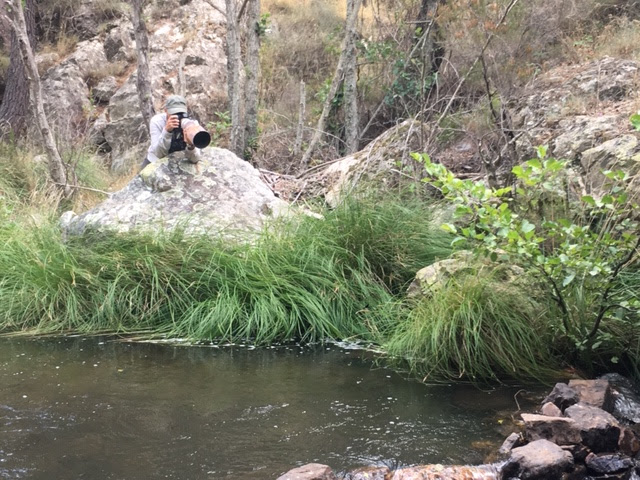
Watching dragonflies with Mark (Martin Kelsey) Late June and July are when things really take off. I am sitting on a water-worn rock in the shadow cast by a single-arch stone bridge. My body adjusts to its smooth contours and I relish its coolness and the shade: a respite from the heat surging from Spanish-blue sky. The ancient bridge, which is just wide enough to walk across, also carries a stone channel along which clear cold water races, on its way to irrigate vegetable gardens  on the other side of the deep valley. Water dribbles from the rim of the arch of the bridge, leaking from this channel, creating  a silvery cascade dripping down to the river below. Dodging this constant trickle, a pair of Red-rumped Swallows bring food every couple of minutes to young hidden in the bowel of their mud-built nest at the apex of the arch. The adults give their friendly budgerigar-like chortle. A pair of White-rumped Swifts zoom up the valley, somewhere they will be using an abando...

Reaching for the sky

Image
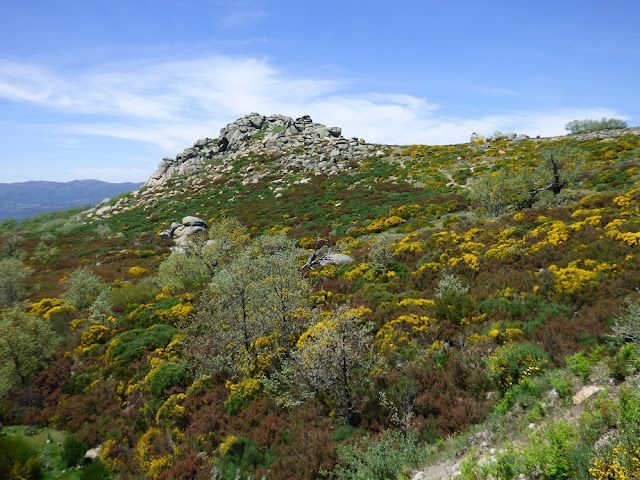
Gredos landscape (Martin Kelsey) On the plains spring is over and the vegetation is blanched blond. Hay has been cut and gathered and harvest is underway. On more lightly grazed land, the dominant shrub is now in flower. A wispy grey-green untidy plant, commonly mistaken by visitors as tamarisk, it is in fact a type of broom called Retama sphaerocarpa . As I drove north from Cáceres, I entered a landscape turned lemon yellow by the sheer abundance of this species, growing on otherwise sparsely vegetated, thin-soiled badlands. It offers a final respite, along with the thistles, before summer closes in, for nectar-seeking insects. But my journey was taking me further, rising a thousand metres more onto open country, the rounded granite mountain tops of the Gredos. Rising through the soft greens of the deciduous Pyrenean oaks, I arrived at a place where spring was just starting. Indeed, the white brooms so characteristic of the granite berrocal near Trujillo, which is in full bloom...

Milestone for an icon

Image
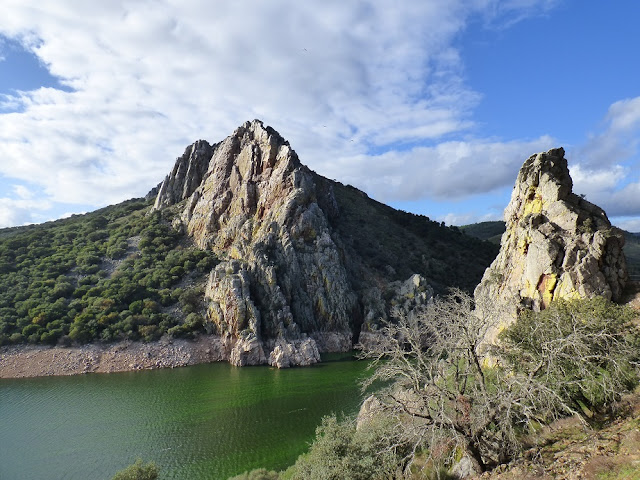
Peña Falcón in Monfragüe National Park (Martin Kelsey) Erupting as a ribbon of parallel ridges across an ocean of dehesa , the hard quartzite strata stand as proud relics to the turbulance of the Variscan orogeny, the tectonic movements that formed the supercontinent Pangea. The results of this collision between the ancient masses of Euramerica and Gondwana can be found in the form of the Pyrenees, some of the Alps (including Mont Blanc) and here in Extremadura, the syncline that shapes the Monfragüe National Park. Standing amongst the visitors at the viewpoint in the southern entrance to the park, I look across onto the the massive Peña Falcón (the Falcon's Rock: which indeed does host a pair of Peregrines). The rock strata laid horizontally as sand on beaches and under the sea about 500 million years ago were metamorphosed into quartzites and slates, violently folded 200 millions years later and pushed vertically as waves across the Earth's crust. "Think about geo...

Town park birding

Image
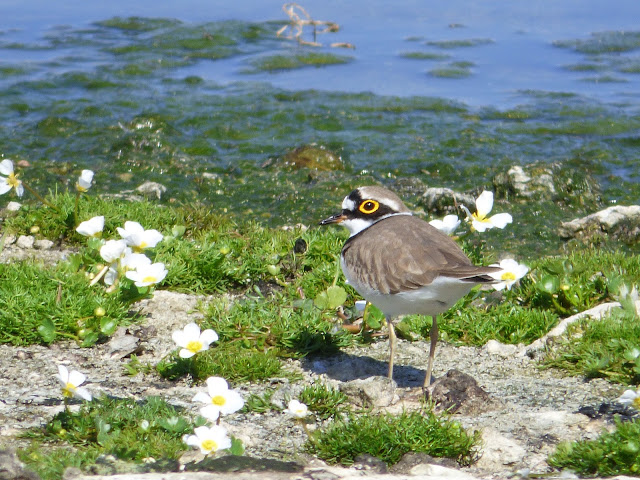
Little Ringed Plover (Martin Kelsey) There is nothing quite so dapper as the ringed plover Charadrius species in breeding dress. Neat and precise black bands crisply border the front half of the bird, contrasting with pure white underparts and, in a modest concession to their surroundings, smooth mud-brown upperparts. Their rotund bodies, rather short legs and simple short bill give them an appealing cuteness, strengthened further by their  typically tentative demeanour. They are hesitant birds, foraging by means of a few paces in one direction, a pause to peer and peck, followed by a few more steps in what seems to be a random trajectory. They seem both endearingly vulnerable and friendly at the same time. In its full nuptual plumage, the Little Ringed Plover blasts its European congeners away with an almost alarmingly swollen ring of bare-skin around the eye. This ripe lemon yellow orbital adorns the dress uniform of the bird like parade-ground braid. Little Ringed Plover...

Eagles in the Spanish savannas

Image
Male Bonelli's Eagle (Martin Kelsey) A western outreach of the Montes de Toledo, the Sierra de San Pedro is a chain of low-altitude mountains dividing the basins of the Tagus and Guadiana Rivers, and acting as a political boundary too, with Cáceres province to the north and Badajoz to the south. It extends for over 60 km, running east-west from the city of Cáceres to the Portuguese border. Part of the Sierra is a Special Protection Area for birds, covering over 115,000 hectares.  Despite its relatively low elevation, from our vantage point, and thanks to a morning of extraordinary clean winter light, we could look north across the plains of Brozas and see the arc of the Central System of mountains, with the snow-capped Serra da Estela in Portugal, spanning east to the Sierra de Gata and then the Sierra de Gredos, the granite wall marking the northern limits of Extremadura, views extending for perhaps 150 kilometres. Sierra de San Pedro (Martin Kelsey) Closer at hand, we...