Posts

Of a swift and nightjar

Image
White-rumped Swift (Mark Johnson) Undetected by our terrestial senses, there was evidently a vast resource of tiny prey items, an "aerial plankton"all around us on the crest of the ridge, as witness the surging groups of House Martins, rising to explore the eddies and whirlpools in the updrafts of air, where millions of tiny invertebrates were being trapped. With the hirundines, were the scythe-winged Common Swifts, pushing barracuda-like in a more predatorial mode, easing parallel to the contour, with a determination that contrasted with the House Martins' cheerful randomness. From our vantage point we looked down and across a vast savannah of dehesa : the dense stippling of holm oaks over the undulating golden-blond pastures of mid-summer, a managed woodland that has become a landscape, typifying, indeed defining, Extremadura.  Solar-powered vultures used nothing more than the thermals of hot-rising air to lift them hundreds of metres into the air, giving them an ...

Exploring eagles

Image
Dark-phase Booted Eagle (John Hawkins) At first glance the Booted Eagle seemed in fixed position in the sky, motionless above us. But as we stood to watch it carefully, the bird was anything but static. To maintain its fix, it was performing a multitude of complex manoeuvres. The bird was head-into-the wind and unseen deliberations were accommodating wind-speed and its fluctuations, variations of direction, the lift it gave against the drag of gravity. The result of being stationary whilst airbourne came not through hovering, when birds are flying forward at the exact speed of the headwind, but more remarkably by gliding at the same speed. The bird made constant adjustments to achieve this: slight tilting of the tail, a flexing of the carpel joint on the left wing, a compensatory spreading of the primary feathers on the right-hand wing. The result was a sensation of fluidity, of both the air with its mysterious flows and eddies far beyond our ken, and of how the eagle responded - f...

Rain's legacy

Image
Woodland the colour of orioles (Martin Kelsey) The cold wet spring has left us with a prolongation of colour which might be considered well-deserved following the onslaughts of sometimes torrential rain and the storms of the last few weeks. Now, as at last the temperature starts to catch-up, my fleece jacket is  consigned to the wardrobe and I can stand at the kitchen door at dusk, listening to the Nightingales and watching the first summer stars break through the gloaming. At the base of the wall beside the orange tree, whose blossom has cast a heavy fragrance to this corner of the house, headily mixed with a nearby jasmine, luminesence the colour of Spica radiates from the abdomens of glow-worms.  I count three in the space of just a few feet. Glow-worm (Patrick Kelsey) The spread of egg-yolk marigold yellow has created a mantle of colour in the dehesas and none so startling as that in a cork oak dehesa that I visited just a few days ago (see photo at the top of...

Bittersweet steppes

Image
Melanistic Montagu's Harrier (John Hawkins) It was the sight of the oddly dusky-looking bird of prey that made us stop and get out of the car. The prolonged glide on rather stiff, slender and angled wings with the slim horizontal form of the tail said Montagu's Harrier. But the dark sooty plumage, interrupted only by almost vestigial barring on the primaries was not the norm: we were looking at the very uncommon melanistic form of the species, indeed the second such individual we had seen that week. It was the middle of April and thanks to this encounter there unfolded a series, a juxaposition of sightings that it would be hard to imagine happening anywhere else than Extremadura and all taking place from where we now stood, with the Sierra de los Lagares, the hill beside which our home nestles. in view and just twenty kilometres in a straight line from us. Free from the confines of the vehicle, now parked in a convenient gateway, we looked across a small valley of pastu...

White frost

Image
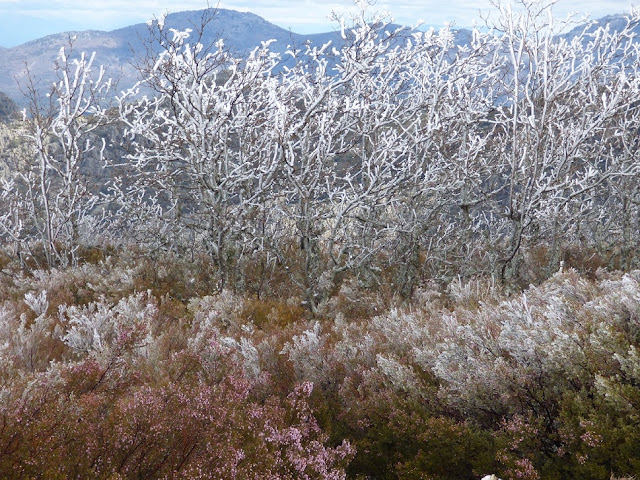
White frost in the Villuercas Mountains (Martin Kelsey) It was the last day of March and as we watched a small group of male Great Bustards on the plains south of home, it was clear that with the rather heavily overcast skies and an unusually chilly westerly wind, they were unlikely to start performing their extraordinary rueda or lekking display. Instead they hautily strode off out of view, leaving us bracing ouselves against the breeze and gazing across an empty field. It must have seemed a crazy suggestion, but stood unchallenged, when I proposed that we drive up high into the Villuercas Mountains, extolling the spectacular landscapes that we could discover there. Thus, we headed east, a relatively short journey, stopping for coffee en route and then climbing through belts of cork oak, cherries and sweet chestnut before entering the gaunt shapes of the bare Pyrenean Oaks. It was as if we had moved back in time by six weeks or more. Half an hour's drive away were decid...

An orchid odyssey

Image
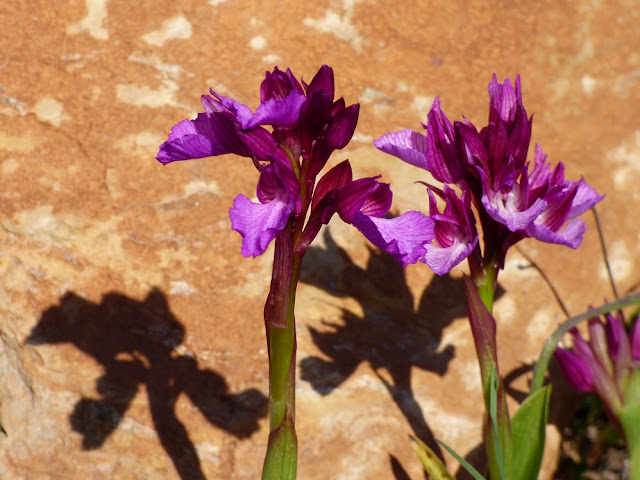
Pink Butterfly Orchid ( Orchis papilionacea ) Martin Kelsey Derek and Zena, Phyllis, John and Peter had asked me for a holiday focused on orchids in Extremadura and thinking about spectacle as well as diversity I recommended late March as the best time. In previous years they had challenged me on butterflies and dragonflies, as well as birds, so I was eagerly looking forward to this new odyssey. However, with the mild winter that we had experienced with some orchids already in flower in late January, I started to get rather anxious that the peculiarities of this year's weather might mean that the best was already over when Derek's group arrived.  I could not have been more wrong.  We have just completed an exhilarating and exciting exploration of our early spring orchids. Sawfly Orchid ( Ophrys tenthredinifera ) Martin Kelsey We started gently, combining birding on the plains west of Trujillo with a walk along a medieval drovers' trail. Here we encountered our ...

Craggy corks

Image
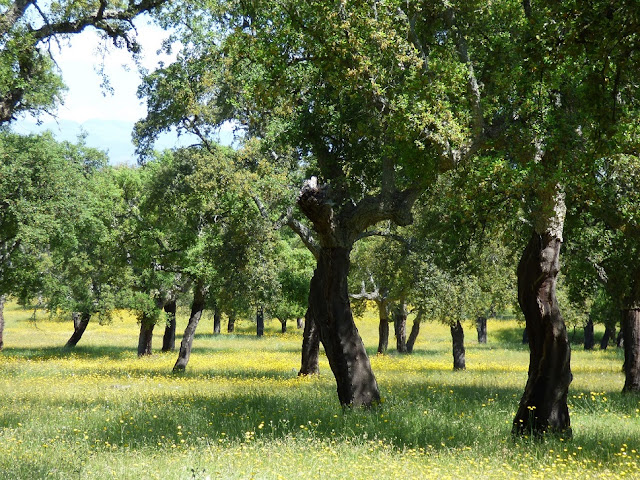
Cork Oak woodland (Martin Kelsey) A hush descended on us as we made the gentle descent, provoked partly by an instinctive response to help our ability to pick-up even the slightest brief bird call, but also I think by the shared sense of reverence. Entering this hidden cork oak glade was like walking into an ancient building, from sunshine into a dappled shade with a pull of heritage. Indeed the very structure of the woodland gave a sense of depth as we looked between the trunks enclosed by a vaulted canopy and the architecture strongly reminded me of a cathedral's crypt. This had resonance with an awareness that the trees' trunks were moulded by generations of men. Like two-toned pillars, the trunks were dusky and even-textured up to the reach of the corking blade, and then as the trunks forked and branches spread, they set a contrast, being deeply fissured and greyed by countless lichens. These trees were in the latter stages of the nine-year cork harvesting cycle, witnes...