Posts

Orchid succession

Image
Bug Orchid (Martin Kelsey) For those who can tell, the colour of the plains and dehesas on this, April's last day, gives a signal. There is a realisation that the course is now set and the arid gold of summer is but countable days ahead. The landscape is still green, but the flowering grasses has pigmented the spring lushness with a lighter, softer, yellowish green...and it is irreversible this side of autumn. Spring feels intense, but short in Extremadura, a dizzy cascading unfurling of events and cycles. There is a visible succession, a phenology, across all life at this time. Wintering birds leave as summer visitors arrive, the different flight times of butterflies, the rolling sequence of colours of the flowers in the dehesas.  In a matter of just four weeks, the cycle of orchids has intensified: emerging spikes, flowering, setting seed and withering. Species that accompanied me just a month ago, with their luring names: Sawfly, Mirror and Early Spider, gave way to Bug and ...
Great Bustard wheels

Image
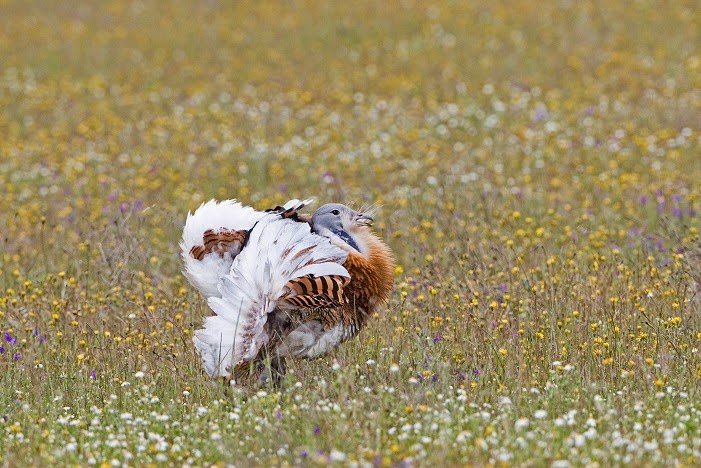
Great Bustard (John Hawkins) In Spanish it is called the rueda (the wheel), in English it is described often as a foam bath....quite different images come to mind, but in spring on the plains of Extremadura they converge to a single meaning....that extraordinary performance of a displaying male Great Bustard. Early this month, on a calm and sunny morning just twenty minutes from home, we stood mesmerised. Across a span of 180 degrees, on fields with sward shaped by sheep, there were six white objects, contrasting strongly with spring's green flush on the meadows. These shapes transformed before us: sometimes pyramidal, sometimes round, the white changing to deep orange. The form depended on the bird's aspect. As it wheeled around slowly, it paused seemingly at 90 degree turns. From the rear it was triangular and white, with the tail pushed upwards and forwards, so all that one could see at the apex of this shape were the white under-tail covert feathers. The sides were co...

Heraldic Bluethroats

Image
Bluethroat (Martin Kelsey) It was the white spot which made us gasp. As it turned to face us, standing with elegance with its long legs, drooped wings and cocked tail, the male Bluethroat transformed. Having shown us its hind view, predominately a grey mousy-brown, with an orange base to the sides of its tail, face-on the difference could not have been more startling. It bore a throat and breast of pure sapphire, carrying a broad darkish band below which untidily merged onto an even broader dark brick-coloured cumberband. But what drew our gaze was its badge of immaculate white, centrally placed amidst the blue. It was almost reflective in its quality, like a medallion, illuminous even. It was hard to think of feathers being the medium for this - it was more like an inlaid little mirror in a Rajasthani embroidery.  Bluethroat (Martin Kelsey) I had a fondness for this particular Bluethroat, as I have watched it many times over the last few months, as it fed within its litt...

Jigsaw spring

Image
My first Woodchat Shrike of 2015 (Martin Kelsey) The jigsaw puzzle that is spring is starting to take form.....every year there is the overture, embracing the exodus of Common Cranes in late February with a dramatic arrival of a first wave of summer visitors. A natural remedy: if we feel bereft at the departure of the winter soundscape of bugling cranes, so the enchantment of months' of engagement with the delightful Lesser Kestrels is gifted to us. Thus by early March, with merely a rump of a few dozen cranes remaining from the tens of thousands, Barn Swallows are already collecting mud for their nests and Short-toed Eagles hang in the sky, as if fixed for the emergence of their serpentine prey from hiberation. The gentle caressing fluty Blackbird song starts and closes the day. The pieces of the jigsaw puzzle fall, in an orderly sequence into place, species by species. The timing, phenology, of arrivals and departures fascinates all, for motives ranging from the science of ev...

At the heart of the landscape

Image
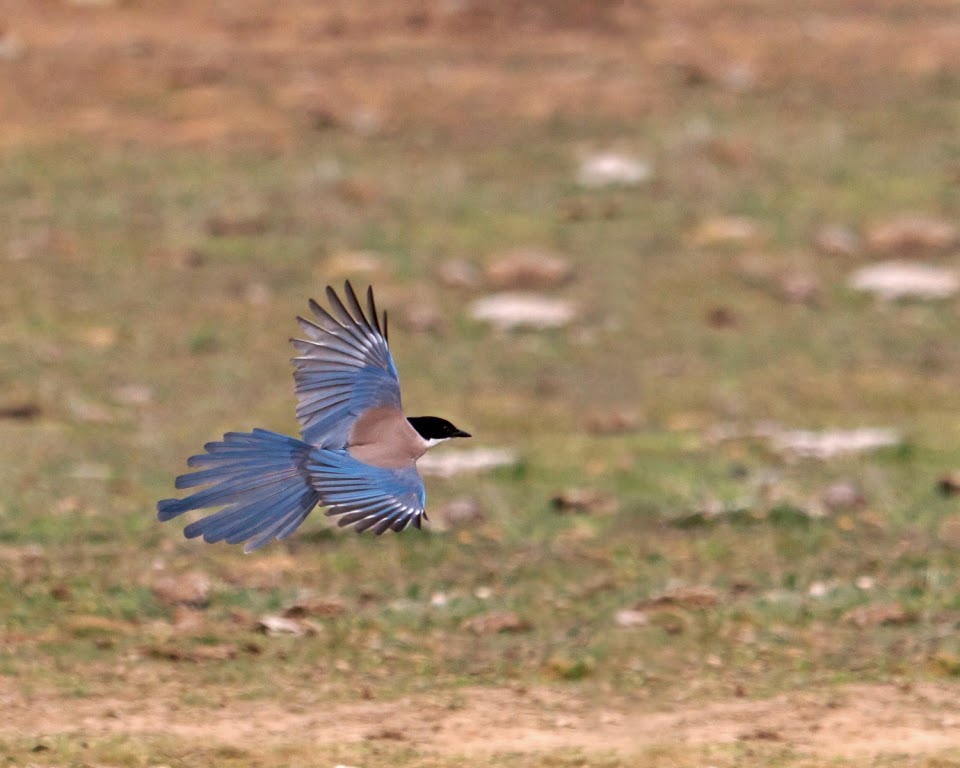
Azure-winged Magpie (John Hawkins) There is symmetry, space and depth, a sense of expansive order. In the near distance, the shadows cast by the trees draw uniform dark bands across the sward. Each tree, individually different, but shaped by human hand through the cycles of pruning to offer a sense of managed nurturing, providing an architecture of form replicated a million times across the landscape.....for this open woodland stretches to the horizon and beyond. And even at the limits of our view, there is the stippling, the shapes of individual crowns. A swooping movement brings my focus back and accompanied by nasal calls a band of Azure-winged Magpies move between the trees, casting gentle arcs of motion, swinging in the same direction, to their communal roost. Winter dehesa (Martin Kelsey) Nothing more typifies the Extremaduran landscape than the dehesa . There is no neat English equivalent word for this habitat, and attempts to define it in anglicised form fail eith...

Golden fury

Image
Golden Eagle (Martin Kelsey) With driving power, using barely half a dozen deep thrusting wingbeats, its dark massive form hurtled around the stand of trees in furious pursuit. Just a minute earlier a peace had hung over the scene, rippled merely by the soft nasal calls of Thekla Larks. Then we had stood under an empty sky, until there appeared in a way that only eagles can master a lone juvenile Golden Eagle. Somehow this bird that had materialised before us was already halfway across the sky....how did we miss its approach? I rationalised about challenges of picking up distant objects against blue skies, its angle of approach reducing detectability even more, but yet again we are gifted by surprise, as conversely its prey would be cursed. That is how eagles have evolved. As it passed, it narrowed its wings, reducing elevation and increasing speed. Too low to follow, we could merely sense its onward direction towards the trees. Then the eruption blew. Loud, urgent yelping cries ...

The game is patience

Image
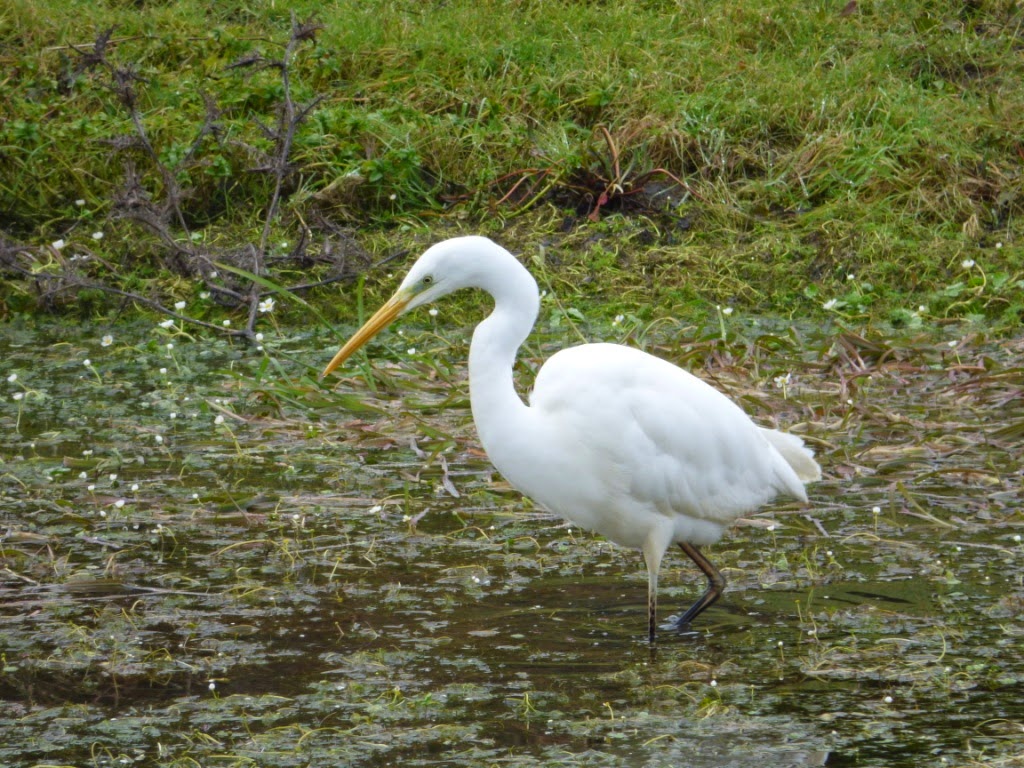
Great Egret (Martin Kelsey) As we approached the tiny circular pond, the Great Egret strode out and stood on a grassy slope close to its edge. Its feeding interrupted, it was stoic and motionless, and waited. We did likewise, cocooned in the vehicle, stationary. Not a word. The white flowers of Water-Crowfoot poked through the meniscus, there was not a ripple. Minutes passed and the game was underway: who would move first? A Robin ticked from the undergrowth nearby....long pauses between its notes, as if the pendulum of time had slowed. Eventually though there had to be a victor and our patience was rewarded. With an almost resigned gait, the egret took the first tentative steps and then, gaining confidence, it strided back down in the water. There its patience took over. It stood, hunched, concealing its serpentine neck and peered. A keen pupil set in a pale lime iris with an outer narrow dark ring made the eye look acute and focussed, tilted forward producing a band of bincular v...